-->
Browsing Category " Government "

Barangay Kagawad Salary


barangay kagawad salary

Barangay Kagawad Salary, How much pare?


This was the question thrown by one of my friends at me. I answered none. A Barangay Kagawad does not receive a salary.


If a barangay kagawad or barangay councilor does not receive a salary then why? you may ask yourself that many Filipinos wanted to be elected to that government position.


Although a Barangay Kagawad does not receive a monthly salary, under the law, Kagawad's are entitled to receive at least 600 pesos each month in the form of an honorarium.


So, the next time somebody will ask you how much is the barangay kagawad salary? say 600 pesos monthly.


Not a substantial amount right?


Honorarium by the way is defined as something given not as a matter of obligation but in appreciation for services rendered, a voluntary donation in consideration of services. It is a remuneration given to a public official for services actually rendered.


Not all kagawad receive this exact amount, some receive more than others.


Why is that?


Because the sangguniang barangay has the power to increase or adjust the amount of honorarium employing a barangay ordinance.


But this power has limitations. What are they:

1. The Kagawad's honorarium can not be more than an amount equivalent to salary 10 in the salary standardization law.

2. The increase can only take effect after the kagawad's term. It will in essence benefit the kagawad who will be elected in the next barangay election.


Salary grade 10 under the third tranche of the salary standardization law is 18,718 pesos.


However, the rates of honorarium prescribed may be increased/adjusted during their term.


How you may ask?


The rates of a kagawad's honoraria can be increased only when:

a. A general salary adjustment for all government employees is granted, or

b. A specific legal basis is issued by a competent authority upgrading the salary grade equivalence of the said barangay officials.


You may want to read:

Prohibited Items At Philippine Airports


prohibited items at philippine airports

To avoid being delayed or detained at any Philippine airport, check out these things that are prohibited. (Prohibited Items At Philippine Airports)


In case you are planning or about to travel via airplane at any Philippine airport, make sure that the following items are not in your luggage or bag, either check-in or carry-on baggage.


Prohibited Items At Philippine Airports


Guns, Firearms, and other devices that discharge projectiles

Acid spray, Insect repellent, Stun gun or any stunning devices except for checked in baggage

Objects with sharp points and edges except for check in baggage

Worker's tools or handyman's tools except for checked-in baggage

Metal chains, Fishing rods, Tripod, blunt instruments except checked in baggage

Liquid, Aerosols, or gel in excess of 100 ml


The Following are the complete lists (http://www.ots.gov.ph/index.php/ots-releases-new-list-of-prohibited-items) of prohibited items at Philippine airports


1. Guns, Firearms, and other devices that discharge projectiles (Prohibited in carry-on and checked-in baggage)


Air gun

Ammunition, Shells, Bullets, and other components

Bolt gun

Component of guns and firearms

Compressed air gun

Firearms

Flare gun

Harpoon gun

Nail gun

Pellet guns

Pistol

Projectile capable devices ( sling-shot, bow and arrow, crossbows) - allowed in checked-in

baggage

Replicas and imitation firearms

Revolver

Rifle

Shotgun

Spear gun

Sport-related firearm


2. Stunning Devices


Acid spray - allowed in checked-in baggage

Insect and animal repellent spray - allowed in checked-in baggage

Mace/Pepper Spray - allowed in checked-in baggage

Stun gun (all kinds) - allowed in checked-in baggage

Tear gas


3. Objects with sharp points and edges - all objects with sharp points and edges are not allowed in the cabin. Any sharp objects in checked baggage should be sheathed or securely wrapped to prevent injury to the baggage handler.


Ax

Bayonet

Bolos

Box cutter

Butterfly knife (balisong)

Canned products with easy-open lids

Cleaver

Cockfighting knives and blades (tare)

Corkscrew

Disguised objects with sharp edges

Diving knife

Hatchet

Ice axes

Ice picks

Knives

Letter openers

Medical scalpel

Nipper/Pusher/Nail file/Nail cutter with knife

Open razors/Razor blades

Pocket comb weapon

Pocket folded knife

Sabers

Scissors

Sword


All of the above are allowed at checked-in or Hold baggage


4. Worker's Tools


Crowbars

Drills/Drill bits including portable power drills

Extension cords

G.I. Wires (Alambre)

Hammers

Nails

Pliers

Retractable tape measure (Metal)

Saws including cordless portable power saws

Screwdrivers

Tapes (Duct tape, Packaging tape, Masking tape)

Wrenches


All of the above are allowed in checked-in or Hold baggage


5. Blunt Instruments


All metal chains

Baton sticks

Billiard sticks

Boat paddles

Bowling/Billiards ball

Cane umbrella

Clubs/Sticks/Bats/Rods

Cricket paddle

Crutches/Walking sticks or aids

Dumbbells/Hand weight

Fishing hooks (large)

Fishing rods

Grindstone knives (Panghasa)

Ice skates/Skateboard

Kayak/Canoe paddles

Knuckles (brass/metal)

Lacrosse sticks

Paintball equipment

Scuba diving equipment

Ski poles/Hiking poles

Tennis/Badminton/Squash rackets

Tripod (large)


All of the above are allowed in checked-in or hold baggage


6. Explosives and incendiary substances and devices


Blasting cap

Detonator and fuse

Grenade

Dynamite

Flares (any form)

Plastic explosive

Pyrotechnics including fireworks

Ammunition

Smoke-generating canisters or cartridges

Mines and other explosive military stores

Replica or imitation explosive devices

Fuels (including cooking fuel and any flammable liquid fuel)

Matches

Lighters (disposable) absorb fluid

Lighter fluids/refills

Disguised lighters

Gasoline/Kerosene/Petrol


7. Liquid, Aerosols, and Gels in individual containers with a capacity not greater than 100 milliliters or equivalent and contained in one transparent resealable plastic bag of a capacity not exceeding one (1) liter or equivalent shall be allowed in the cabin.


Only one (1) transparent 20cm X 20cm resealable plastic bag shall be allowed for each passenger. The contents of the plastic bag shall fit comfortably and the bag shall be completely closed. Exceptions should be made for medications, baby milk/food, and special dietary requirements.


All types of LAGs regardless of volume when labeled as flammable (highly combustible and self-igniting by chemical reaction), corrosive or toxic are not allowed in the cabin or in the hold.


The following items are allowed at the Philippine airports

1. Baby formula and breast milk if a baby or small child is traveling

2. All prescription and over-the-counter medications including KY jelly, eye drops, and saline solutions for medical purposes.


You may want to read:

How Much Is The Price Of Sardines In The Philippines?

 How Much is The Price of Sardines In the Philippines?


I have been away from the Philippines for too long. I started working abroad in 2006. A Small can of non-branded sardines at the time is between 7 pesos and 9 pesos.


I wonder how much it costs now?


DTI, the Philippine government agency regulating the prices of basic commodities in the Philippines posted the following suggested retail price for sardines and other basic commodities.


A Seller selling way beyond the suggested retail price will get into trouble. Their license to sell can be revoked by the government.


The Price of Sardines in the Philippines based on the suggested retail price posted by the Department of Trade and Industry are the following:


Capitan Del Mar Spanish Style Sardines in Soybean Oil 155g 42 pesos (as of June 2022)

Ligo Sardines with Calamansi 155g 36 pesos (as of June 12, 2022)

Lucky 7 Sardines in Tomato Sauce 155g 16.6 pesos(as of June 12, 2022)

Lucky 7 Sardines hot 155g 17.50 pesos (as of June 12, 2022)

Young's Town Sardines Red Easy Open 155g 18.50  pesos (as of May 22, 2020)

Toyo Sardines 155g 15.00 pesos

Toyo Sardines Red 155 g 15.00 (as of May 22, 2020)

Family's Brand Sardines Chili 155g 19.50 pesos (as of May 22, 2020)

Hakone Sardines Tomato Sauce Hot 155 grams 22.48 pesos (as of May 22, 2020)

King Cup A1 Sardines Red 155g 18.50 pesos (as of May 22, 2020)

Mariko Sardines 155g 17.16 pesos (as of July 24, 2020)

Master Hot Sardines Bonus 155g 21.50 pesos (as of May 22, 2020)

Mikado Sardines 155g 18.50 pesos (as of May 22, 2020)

Hakata (Easy Open Can) 155g 14.00 pesos

Mega Sardines 155g 20.00 pesos (as of June 12, 2022)

Paradiso Sardines Red Easy Open 155g 18.50 pesos (as of May 22, 2020)

Rose Bowl Gold Sardines in Tomato Sauce 425g 75 pesos (as of June 12, 2022)

555 Sardines in tomatoes sauce 155g 19.00 pesos (as of June 12, 2022)

555 Sardines Hot 155g 19.50 pesos (as of May 22, 2020)

Ligo Sardines green 155g 19.00 pesos (as of May 18, 2020)

Swan Sardines Green 155 g 16.50 pesos (as of May 22, 2020)

Unipak Sardines Chili 155 g 18.50 pesos (as of May 22, 2020)

1 Box Unipak Sardines Php 1,625.00 (as of June 8, 2020)

Atami Sardines Red 155g 17.50 pesos (as of May 22, 2020)

1 Box Atami Sardines (Quantity 100) Php 1,650.00 (as of June 8, 2020)


The above price of sardines in the Philippines is among the cheapest. At least you now have an idea of how the other branded sardines costs.


Most of us OFWs and Filipino expatriates are no longer aware of the prices of basic commodities in the Philippines to the point that when our families back home ask for more money to buy food, we say, "magtipid naman kayo".


Posted hereunder are the prices of some basic commodities for the benefit of You OFWs and Filipinos abroad so when you take your vacation, you will not be surprised.


Condensed Milk


Alaska sweetened filled milk 300ml - 54.50 pesos

Milkmaid full cream 300 ml - 67.00 pesos


Evaporated Milk


Alaska Filled Milk 370ml - 39.50 pesos

Alpine Full Cream Milk 370ml - 54.00 pesos


Powdered Milk


Alaska Powdered Milk Drink 150g - 43.50 pesos

Bear Brand 150g - 50.00 pesos

Anchor Full Cream Milk 150g - 73.30 pesos

Birch Tree Full Cream Milk 150g - 57.10 pesos


Coffee Refill


Blend 45 25g - 16.75 pesos

Blend 45 50g - 33.50 pesos

Great Taste Granule 25g - 18.75 pesos

Great taste Granule 50g - 37.50 pesos

Nescafe Classic 25g - 19.70 pesos

Nescafe Classic 50g - 39.40 pesos


Bread


Pinoy Tasty 450g - 35.00 pesos

Pinoy Pandesal (10pcs./pack) - 21.50 pesos


Instant Noodles


Lucky Me 55g - 7.30 pesos

Payless 55g - 6.30 pesos

Quickchow 55g - 6.60 pesos


Detergent/Laundry Soap


Mr.Clean (blue bubbles) 420g - 20.50 pesos

Surf Bar (Kalamansi) 380g - 20.00 pesos

Speed Bar 380g - 19.50 pesos

Budget Bar 390g - 16.35 pesos

Champion Bar 390g - 20.00 pesos


Luncheon Meat


CDO 165g - 30.95 pesos

Purefoods Chinese Style 165g - 32.50 pesos


Meat Loaf


Argentina 150g - 17.00 pesos

555 150g - 16.75 pesos

CDO 150g - 16.95 pesos

Gusto 150g - 16.50 pesos

Winner 150g - 16.50 pesos


Corned Beef


Argentina 150g - 29.50 pesos

CDO 150g - 26.50 pesos

Purefoods Star 150g - 29.00

Ligo Premium 175g - 35.80 pesos

Winner 150g - 28.00 pesos

El Rancho 150g - 26.00 pesos

Young's Town 150g - 27.00 pesos


Condiments - Vinegar


Datu Puti (White Vinegar) 350ml - 13.50 pesos

Amihan Cane 350ml - 10.40 pesos

Silver Swan 350ml - 13.50 pesos


Condiments - Patis


Datu Puti 350ml 19.95 pesos

Nelicom Special 350ml - 22.95 pesos

Silver Swan 350ml - 19.95 pesos

Lorins (Budget Pouch) 350ml - 16.80 pesos


Soy Sauce


Datu Puti 340ml - 15.75 pesos

Silver Swan 340ml - 15.75 pesos


Toilet Soap


Safeguard 90g - 28.00 pesos

Ivory 90g - 19.00 pesos


Batteries


Eveready Heavy Duty (Pack of 2) AA - 26.50 pesos

Eveready Superheavy Duty (pack of 2) AA - 38.75 pesos

Energizer Max Pack of 4) AA - 167.00 pesos

Eveready D (Pack of 2)- 47.25 pesos


You can make a complaint against a supermarket or store that price their products

way beyond the DTI-suggested retail price by reporting personally to any regional

or provincial DTI office in your area.


Much better if you call them on these DTI hotlines:


7513330

09178343330


You may want to read:


What are the grounds for CLOA Cancellation?


grounds for cloa cancellation

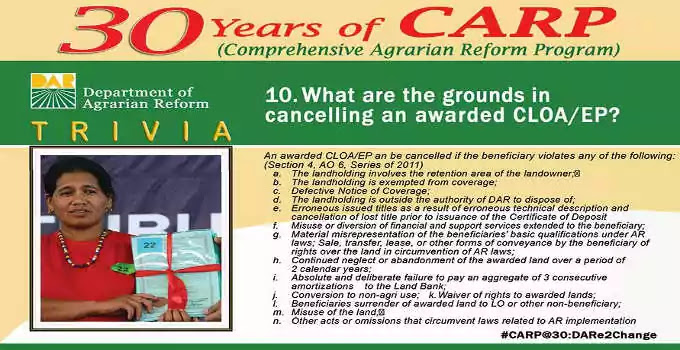
What are the grounds for CLOA Cancellation?


CLOA (Certificate of Land Ownership Award) by the way is a document or we can call it the end-product of the Comprehensive Agrarian Reform Program (CARP) under the auspices of RA 6657 otherwise known as The Comprehensive Agrarian Reform Law being implemented by the Department of Agrarian Reform (DAR).


Basically, CLOA is a Title of Land issued by the DAR and must be registered at the Registry of Deeds (ROD).


The Grounds for CLOA cancellation are the following:

  • The landholding involves the retention area of the landowner
  • The landholding is exempted from coverage
  • Defective notice of coverage
  • The landholding is outside of the authority of DAR to dispose of
  • Erroneously issued titles as a result of erroneous technical descriptions and cancellation of lost title before issuance of the certificate of deposit
  • Misuse or diversion of financial and support services extended to the beneficiary
  • A material misrepresentation of the beneficiaries' basic qualifications under the agrarian reform laws: sale, transfer, lease, or other forms of conveyance by the beneficiary of rights over the land in circumvention of agrarian laws
  • Continued neglect or abandonment of the awarded land for 2 calendar years
  • Absolute and deliberate failure to pay an aggregate of 3 consecutive amortization to the land bank
  • Conversion to non-agricultural use
  • Waiver of rights to awarded lands
  • Beneficiaries surrender of awarded land to the landowner or other non-beneficiary
  • Misuse of the land
  • Other acts or omissions that circumvent laws related to agrarian reform implementation


How to apply for CLOA Title?


There are no specific requirements for the CLOA application. The DAR only requires that you are a tenant farmer and that the farm being cultivated or tilled has a tenancy agreement or arrangement with the landowner.


Accordingly, the farmers are the direct beneficiaries of the CARP, which is basically the distribution of farmland to landless farmers.


In the process of the determination of farmer-beneficiaries, the Municipal Agrarian Reform Office (MARO) shall identify and determine the qualified beneficiaries with assistance from the BARC – Barangay Agrarian Reform Committee (DAR Adm. Order No.5,  Series of 1989).


It would take a long process of documentation and validation before the issuance of CLOA.


It involves from the MARO to the PARO (Provincial Agrarian Reform Office) for review, then to the RARO (Regional Agrarian Reform Office) for further review and evaluation, and eventually for a recommendation for approval to the higher authority – the Secretary of DAR.


In case a CLOA title is awarded to the wrong beneficiary, you can advise the truly qualified farmer-beneficiaries to file a petition for nullification of the CLOA Title at the DARAB (Dept. of Agrarian Adjudication Board) in your locality citing that the bonafide or the legitimate farmers have not given the preference in the determination of beneficiaries as mandated under the law.


You may like to read:


How Much Is The Salary of Punong Barangay?


salary of punong barangay

Do you have an idea how much is the salary of Punong Barangay?


You will elect a Punong Barangay in the place where you registered to vote.


Perhaps more than 5 or 10 candidates are vying for the position of barangay chairman or punong barangay in your area.


You may wonder why these people wanted the position so much that they sometimes violated the Comelec prohibition not to spend more than Php 5 pesos per registered voter in the place they intend to be elected.


Is the Salary of Punong Barangay substantial enough that they can recover the amount they spend on their campaign?


I asked myself this question, How much does a Barangay Chairman/Punong Barangay earn each month in the form of salary?


I found out that there is a law that says that in no case shall the salary of Punong barangay be less than One thousand pesos (1,000.00) per month.


Actually, the term used under the law is not salary.


The wording of the law says that a Punong Barangay shall be compensated in the form of an honorarium at an amount not less than P1,000 per month.


So, A punong barangay does not receive a salary but only an honorarium.


But how much is this Honorarium?


Now we know that it is at least 1,000 per month because the law says the monthly honorarium must not be less than 1,000 pesos a month.


Under the law, the compensation of a Punong Barangay is equated to a government position with a salary grade 14.


Salary Grade 14 under the salary standardization law is equivalent to 30,253 pesos. This is under the so-called 4th trance of the salary standardization law of 2015. The amount mentioned will take effect in the year 2019.


The Salary of Punong Barangay, I mean the monthly honorarium of a Punong Barangay or Barangay Chairman shall not exceed that amount.


Adjustment of the honoraria rates shall not exceed the minimum for positions with salary grade 14 the rates of which are based on the salary schedule being implemented by the city or municipality where the barangay is situated.


You might ask, Can the minimum honorarium of 1,000 pesos be adjusted or increased?


The answer is yes.


The Barangay concerned through a barangay ordinance has the power to do so but there is a limitation.


It must not be more than the amount equivalent to salary grade 14. Any increase will take effect only after the expiration of the full term of office for which the punong barangay was elected.


Your next question might be, Can the monthly honorarium of a Punong barangay be increased beyond the Salary Grade 14 limit?


The answer is yes.


The rates can be increased only when:

a. A general salary adjustment for all government employees are granted, or

b. A specific legal basis is issued by competent authority upgrading the salary


So, the Sangguniang barangay is prohibited from granting any adjustment in excess of the amounts authorized.


Granting that the honorarium is increased, from where will the fund comes from?

The amount necessary for the implementation of honorarium/salary adjustments shall come from the respective barangay funds.


Said amount shall be provided for in an appropriation ordinance to be enacted by the Sangguniang Barangay and henceforth shall be included in the budget of the barangay.


Aside from the monthly honorarium, a Punong Barangay is entitled to the following benefits:

  • Christmas bonus in the form of a cash gift at the rate authorized by law (5,000)
  • Insurance coverage under RA 6942
  • Medical care consists of free hospitalization in government hospitals, In an extreme emergency, the barangay chairman may be confined in private hospitals with expenses chargeable against barangay funds at not more than P5,000
  • Free tuition and matriculation fees in government schools in their area, including two of their legitimate dependent children during their term of office only
  • Conferment of civil service eligibility
  • Preference in appointment to any government position to which they are qualified


The insurance coverage mentioned above shall include:

  • temporary and permanent disability
  • accident insurance
  • death benefit
  • burial benefits


In the event of the death of a Punong Barangay during his incumbency, his beneficiaries shall be entitled to Twenty thousand pesos (P20,000.00)


Should a barangay chairman be assassinated or killed while in the performance of his duties or on the occasion thereof, his beneficiaries shall be entitled to double the amounts of indemnity provided above?


In the event of total and permanent incapacity or disability as determined by the Government Service Insurance System (GSIS) a punong barangay shall be entitled to Twelve thousand pesos (P12,000.00.)


Provided, That the disability occurred during his incumbency whether work-connected or not.


In addition to the disability benefits, a burial benefit of Two thousand pesos (P2,000.00) shall be paid to his beneficiaries if death occurs within two (2) years from the onset of total and permanent incapacity or disability.


Here are some benefits to which a Punong Barangay is not entitled.

  • Clothing Allowances
  • Hazard Duty Pay
  • Representation and Transportation Allowances (RATA)
  • Personnel Economic Relief Allowances (PERA)
  • Productivity Incentive Bonus (PIB)
  • Clothing Allowance
  • 13th month pay
  • Anniversary Bonus


Do barangay officials earn leave credits and are they entitled to terminal leave benefits?


The issue may be referred to the Civil Service Commission being the proper authority on this matter. The point of consideration is that barangay officials are not receiving salaries which should be the basis for the computation of leave credits under existing laws.


What do you think? Is The Position of a Punong Barangay worth fighting for?


You may want to read:


Who will succeed the Punong Barangay? In case of death


Who will succeed the Punong Barangay?

Who will succeed the Punong Barangay? In case of death, removal from office, physical incapacity, or failure to qualify.


I read this post by DZMM Teleradyo, to wit:


kapapanalo pa lamang na kapitan sa Brgy.Duhatan Balayan sa Batangas na si Barangay Kapitan Jingo Sherwin Barros, patay sa pamamaril kaninang hapon, kasamahan nito, sugatan.


If a Barangay Captain or Barangay Chairman dies, permanently incapacitated or removed from office. Who will be the next Barangay Kapitan?


Who will succeed the Punong Barangay or Barangay Captain in case of his/her death?


The highest Sangguniang barangay member or in case of his permanent inability, the second-highest-ranking Sangguniang barangay member shall become the Punong Barangay/Barangay Captain.


The second placer in the election for Punong Barangay will not be new or will not succeed as the new Punong Barangay.


Who will succeed the Punong Barangay? In the case of Death


How about if the Punong Barangay elect died before taking his oath and assuming his office's functions?


The same. If a permanent vacancy occurs in the office of the punong barangay, the highest-ranking Sangguniang barangay member or in case of his permanent inability, the second-highest-ranking Sangguniang member shall become the punong barangay.


The successors shall serve only the unexpired terms of their predecessors.


A permanent vacancy arises when an elective local official fills a higher vacant office, refuses to assume office, fails to qualify, dies, is removed from office, voluntarily resigns, or is otherwise permanently incapacitated to discharge the functions of his office.


Because of his death, the elected Punong Barangay can no longer assume and take his oath of office. His failure to accept and take his oath of office will result in his failure to qualify for the office of punong barangay.


Since he failed to qualify, this would thereafter render his position permanently vacant. Since there is a permanent vacancy in the office of punong barangay, the rule on succession as provided by section 44(b) of the local government code is applicable.


Based on the provision, in case of a permanent vacancy in the office of the punong barangay, the highest-ranking Sangguniang member or in case of his permanent inability, the 2nd highest-ranking Sangguniang barangay member shall become the punong barangay.


The 7th place vacancy in the Sangguniang barangay shall be filled by appointment to be issued by the Mayor.


You may want to read:


BFP Fire Alarm Levels


bfp fire alarm levels

What Do You Need To Know About (Bureau of Fire Protection) BFP Fire Alarm Levels?


Fire Alarm Level - Estimated Infrastructure Affected - Estimated Fire Trucks Needed


Fireout - Fire has been neutralized

Under Control - Decreasing Fire Risk

General Alarm - Fire Affecting Major Part of Area - 80 Fire Trucks

Task Force Delta - Affecting Significant Part of Area - 36 Fire Trucks

Task Force Charlie - Affecting Significant Part of Area - 32 Fire Trucks

Task Force Bravo - 15 X 15 Houses - 28 Fire Trucks

Task Force Alpha - 12 X 12 Houses - 24 Fire Trucks

Fifth Alarm - 10-11 Houses or High Rise Building - 20 Fire Trucks

Fourth Alarm - 8-9 Houses or High Rise Building - 16 Fire Trucks

Third Alarm - 6-7 Houses or High Rise Building - 12 Fire Trucks

Second Alarm - 4-5 Houses - 8 Fire Trucks

First Alarm - 2-3 Houses - 4 Fire Trucks


Image Credit: BFP San Jose Batangas Facebook Page


You may want to read:

Reynaldo P. Arcenas Jr., Master Teacher

Reynaldo P. Arcenas Jr., Master Teacher


Pagsuporta sa 4Ps Bicol: In Palanas, Masbate, the Pantawid Pamilyang Pilipino Program (4Ps) has found staunch support in the familiar face of teacher Reynaldo Arcenas Jr., who was once a 4Ps staff of the DSWD Field Office V. Now a Master Teacher I at the Maravilla National High School, he is carrying his commitment to 4Ps’ goals over into his new mission of shaping his students’ future through teaching.


As the designated 4Ps coordinator of the said school, he conducts 4Ps orientations for co-teachers, co-organizes youth development sessions, and holds parental literacy programs and other activities that highlight education, children’s rights, and parental responsibilities. Additionally, he helps coordinate home visits for household beneficiaries with discrepancies in meeting the program criteria.


Teacher Reynaldo previously worked as a Listahanan staff and Social Welfare Assistant at the Department, where he said he learned valuable skills in situation management and service provision. Now, as an education champion, he said he attributes his current position to the valuable insights he learned in the past, including during his tenure at the DSWD.


The collaboration among DSWD FO V and government and non-government organizations is crucial in the strategic implementation of social welfare programs and services that are intended to improve the living conditions of poor, vulnerable, and disadvantaged Bicolanos in the region.


Source: @dswfo5

Official Logo for the 150th Birth Anniversary of Emilio Jacinto

Official Logo for the 150th Birth Anniversary of Emilio Jacinto


Here’s a closer look at the newly launched commemorative logo for the 150th Birth Anniversary of Emilio Jacinto, the brains of the Katipunan, for his 149th Birth Anniversary.


The design features a rectangular box in two colors. The upper 3/4 of the box contains a vector version of Jacinto’s portrait on the left with “PINGKIAN 150” in bold red letters on the right side. The center of the “0” is the image of a Pingkian “Flint Stone” that also appears as a stylized human brain image. This pays homage to Jacinto’s nom de guerre “Pingkian” and the title “Brains of the Katipunan” ascribed to him by succeeding generations. In the bottom 1/4 are the words “Emilio Jacinto 1875 – 15 December – 2025″ Light and Dark monochrome backgrounds are also authorized.


The design was created by NHCP Creative Arts Specialist Jovan C. Soriano and formally launched during the commemorative lecture and sesquicentennial birth anniversary launch program hosted by the GSIS Museo ng Sining and the NHCP on 11 December 2024.

The coat of arms of the Philippines Commonwealth

Coat of arms of the Philippines Commonwealth
The coat of arms of the Philippines Commonwealth | @nhcpofficial

The coat of arms of the Philippines Commonwealth 

Inauguration of the Philippine Commonwealth (15 November 1935)

Today’s feature highlights the coat of arms of the Philippine Commonwealth, adopted on 6 November 1935 under Act No. 4258, approved by then-Governor-General Frank Murphy. The coat of arms depicts a shield divided into two vertical halves, incorporating the colors and symbols of the Philippine flag. At the top (chief) are three stars equidistant from each other. Within the shield is a smaller shield displaying the arms of Manila, featuring a golden castle representing Spain and a golden sea lion holding a sword hilt in its paw. The crest showcases an American eagle, and beneath the shield is a scroll inscribed with the words “Commonwealth of the Philippines.”

On this day, the Philippine Commonwealth was inaugurated, with Manuel L. Quezon and Sergio Osmeña Sr. serving as president and vice president, respectively. Under the Tydings-McDuffie Act, the Philippines entered a transitional government period to prepare for full independence. The election of Quezon and Osmeña marked a significant milestone, as they were the first Filipinos to serve as heads of government—a product of the nation’s efforts toward self-governance.

The inauguration took place on the steps of the Legislative Building in Manila, drawing a crowd of 300,000 people.

National Indigenous Peoples Month

Under Presidential Proclamation 1906, signed in 2009, the month of October is declared ‘National Indigenous Peoples Month’ in celebration, recognition, and protection of the rights of Indigenous Cultural Communities (ICCs)/IPs.

For 2024, the theme of Dayaw is “Katutubong Filipino: Pagtibayin ang Tagumpay 2030 (Indigenous Filipinos: Strengthening the Success by 2030), which highlights how the celebration will focus on the significant role in bolstering the accomplishments and progress of the Northern, Central, and Southern Cultural Communities, focusing on sustaining and enhancing their successes while safeguarding their ICH as we approach the year 2030.


Join us as we celebrate the colorful traditions and the vibrant cultures of our indigenous peoples.


Maki-Dayaw na!


NCCA Composition Prize

NCCA Composition Prize
NCCA Composition Prize | @nccaofficial

NCCA Composition Prize

NCCA opens its Call for Entries to the 2024 Composition Prize! The deadline for submission is on December 28, 2024.

The National Commission for Culture and the Arts (NCCA) Composition Prize is a biennial award given to winning and/or deserving composers for each category. Initiated in 2016, it is a competition on concert hall music, which calls for extended works that go beyond popular or traditional music-writing or improvisation, and thus can be better judged or evaluated if codified with acceptable standard notation that may be published and recreated later through a performance.

For the complete guidelines, scan the QR Code or visit https://ncca.gov.ph/ncca-composition-prize-2024/

Bomb Jokes and Threats are prohibited inside museum premises

Bomb Jokes and Threats are prohibited inside museum premises
Bomb Jokes and Threats are prohibited inside museum premises | @natmuseumph

Bomb Jokes and Threats are prohibited inside museum premises 

To our dear museum guests: Please be reminded that making jokes, threats or unverified claims and other statements that refer to bombs, weaponry, or other violent instruments is punishable by law under Presidential Decree No. 1727, and may result in a punishment of imprisonment of up to five (5) years or a fine of up to ₱40,000.00.

Any such expressions made inside NMP premises will be treated with utmost seriousness by our Security Management Section and law enforcement authorities and shall be dealt with accordingly.

The Manila Post Office Building Fire

The Manila Post Office Building Fire

Today marks the first anniversary of the fire that gutted the venerable Manila Central Post Office Building at Plaza Lawton, Ermita.


In the late hours of May 21, 2023, smoke and fire were detected at the Post Office Building. Firefighters and volunteers rushed to the scene to control the blaze, which they determined was coming from the basement. The fire seemed contained for several hours until, in the early hours of May 22, flames finally broke out of the basement. It moved upwards, consuming the woodwork and all flammable materials inside the structure. Fire would soon engulf the whole building, the likes of which it hadn’t seen since the Battle of Manila in 1945. By midday of May 22, the fire had mostly been put out. However, it was only on May 23 that the Bureau of Fire Protection declared the fire out, signaling the end of the massive fire. By then, only the gutted remains of the Post Office Building remained standing.


Months before the fire, Renacimiento Manila organized several heritage walks in the Lawton-Arroceros Area, including a tour of the post office building, which was conducted in partnership with Pilipinas Philately.


Today, the desolate ruins of the Post Office Building continue to loom over Plaza Lawton. Plans are underway to restore the building, although its future use remains to be determined.


Jose Abad Santos Day

José Abad Santos Day is observed in the province of Pampanga and Angeles City every May 7, commemorating Chief Justice Abad Santos’s execution. The date of his execution is widely known and often reported as May 7 or May 2, but the National Historical Commission of the Philippines (NHCP) ascertains May 1, 1942, to be the date of his execution using Japanese war crime records found in the National Archives of the Philippines.


Nick Joaquin

Nick Joaquin
Nick Joaquin | @nccaofficial

Today, May 4, 2024, is the 107th birth anniversary of National Artist Nick Joaquin.

Nicomedes M. Joaquin is regarded by many as the most distinguished Filipino writer in English writing so variedly and so well about so many aspects of the Filipino. Nick Joaquin has also enriched the English language with critics coining “Joaquinesque” to describe his baroque Spanish-flavored English or his reinventions of English based on Filipinisms.

Aside from his handling of language, Bienvenido Lumbera writes that Nick Joaquin’s significance in Philippine literature involves his exploration of the Philippine colonial past under Spain and his probing into the psychology of social changes as seen by the young, as exemplified in stories such as Doña Jeronima, Candido’s Apocalypse and The Order of Melchizedek. Nick Joaquin has written plays, novels, poems, short stories, and essays including reportage and journalism. As a journalist, Nick Joaquin uses the nom de plume Quijano de Manila but whether he is writing literature or journalism, fellow National Artist Francisco Arcellana opines that “it is always of the highest skill and quality”.

Read more: https://ncca.gov.ph/about-culture-and-arts/culture-profile/national-artists-of-the-philippines/nick-joaquin/

You may want to read:

Dr. Ligaya S. Lacsina

Dr. Ligaya S. Lacsina
Dr. Ligaya S. Lacsina | @natmuseumph

Dr. Ligaya S. Lacsina is a maritime archaeologist specializing in Southeast Asian watercraft construction. In 2009, Dr. Lacsina received her Master of Arts in Archaeology from the University of the Philippines.

Later, in 2016, she received her Doctor of Philosophy in Maritime Archaeology from Flinders University in Adelaide, South Australia with a doctoral thesis examining the Butuan boats.

She previously served as a researcher for the National Museum of the Philippines’ Archaeology Division beginning in 2004, and later as a researcher and curator for the Maritime, Underwater and Cultural Heritage Division from 2016 to 2021.

Dr. Lacsina is currently an Associate Professor at the University of the Philippines’ School of Archaeology.

You may want to read:

Dr. Carmencita Padilla

Dr. Carmencita Padilla
Dr. Carmencita Padilla | @nastphl

LOOK: Newly conferred National Scientist Carmencita Padilla featured on Vogue PH!

Raising Hope: Dr. Carmencita D. Padilla, The Filipina National Scientist Saving And Protecting Lives Through Genetic Research

“Her pioneering research on inborn errors of metabolism among Filipinos provided the scientific basis for the enactment of Republic Act 9288, or the Newborn Screening Act of 2004, of which she was the most active advocate,” says Dr. Dolores A. Ramirez, who nominated Dr. Padilla for Vogue Philippines’ Raising Hope.

Check out the inspiring article on Vogue PH through this link: https://vogue.ph/international-womens-day/raising-hope-dr-carmencita-d-padilla-the-filipina-national-scientist-saving-and-protecting-lives-through-genetic-research/

You may want to read:

What is a mining fiscal regime?

What is a mining fiscal regime? 

It is a set of policy tools-such as royalties and taxes – formulated by the government for it to have a share of the economic value generated from mining activities.

It determines how revenue from mining projects is shared by the government, citizens, and mining companies.

The government is responsible for ensuring that the revenue generated from the mining of nonrenewable resources is used for economic development.

The Philippine mining industry plays a vital role in the country’s economic development, and having a clearly defined set of policy tools is imperative for the proper management of the country’s mineral resources.

The current mining fiscal regime is complex, resulting in investor uncertainty.

Therefore, the Department of Finance (DOF) proposes to rationalize the Philippines’ mining fiscal regime by simplifying the tax system, allowing the government to collect its fair share of mining revenues, and establishing good governance in the sector.

This will not only improve tax compliance but also enhance the ease of doing business, which will encourage more revenue- and job-generating investments to enter the country.

The reform is expected to generate PHP 47 billion in incremental revenues from 2024 to 2028.


Why do we need to rationalize or restructure the Philippines’ mining fiscal regime?
1. To increase the Philippines’ competitiveness with other countries and make the industry more attractive to investors by
simplifying the tax system.
2. To allow the government to collect its fair share of mining revenues when prices of metallic minerals are significantly high.
3. To establish good governance and ensure that transparency and accountability is upheld throughout the extractives value chain.

Salient Features of the Proposed Fiscal Regime

Salient Features of the Proposed Fiscal Regime

You may want to read:

Kalutong Filipino, Lakas ng Kabataang Makabago

kalutong filipino
Kalutong Filipino, Lakas ng Kabataang Makabago |@nccaofficial

Kalutong Filipino, Lakas ng Kabataang Makabago

Pursuant to Presidential Proclamation No. 469, which established April as Filipino Food Month (FFM) or Buwan ng Kalutong Pilipino, the National Commission for Culture and the Arts, in partnership with the Department of Agriculture, the Department of Tourism, and the Philippine Culinary Heritage Movement, is leading the month-long celebration for 2024 with the theme “Kalutong Filipino, Lakas ng Kabataang Makabago.”

Celebrate FFM with us by using the official promotional collaterals included in the festival kit: http://tinyurl.com/FFM-2024-Festival-Kit
We also encourage everyone to create their own activities in line with the celebration and include it in our official calendar of events by answering this Google Form: http://tinyurl.com/FFM-2024-Activities

See you on April 2024. Mabuhay ang Kalutong Pilipino!

You may want to read: